


From the makers of
80+ delivered projects
Chaka WAP: At Home in WhatsApp
A local-first AI that joins WhatsApp conversations as a human-like participant, learning the style of every chat it's in.
10x
Faster reads after moving vectors from strings to binary BLOBs in SQLite.
384-dim
Embeddings generated locally with transformers, for private, cost-free retrieval.
$0
Spent on cloud embedding APIs since they were replaced with local transformers.
5–8
Recent messages read to mirror a person's syntax, capitalisation and slang.

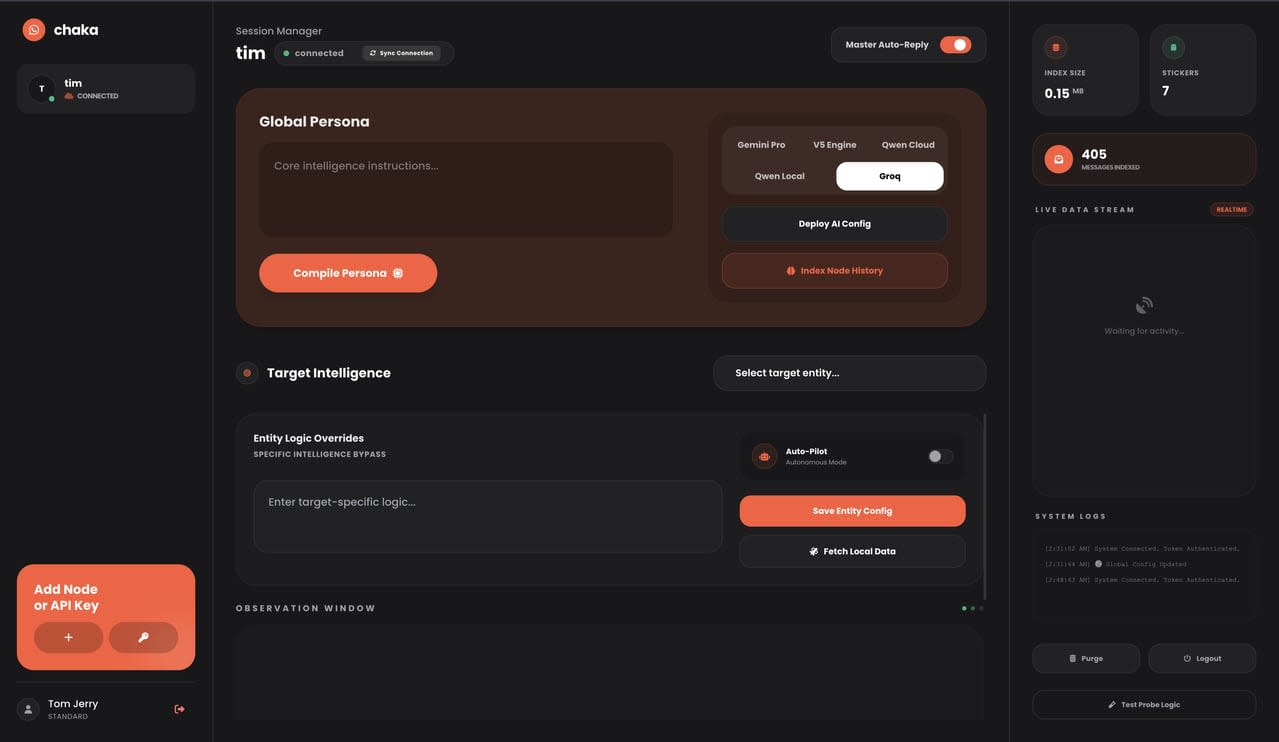
The Live Console
A real-time dashboard in Vanilla JS, Tailwind and Socket.io for live telemetry and logs, from 4K monitors down to phones.

Dynamic Style Learning
It reads the last 5–8 messages and mirrors syntax, capitalisation and Nigerian Pidgin, so every reply fits the room.

Ironclad Failover
When a model hits its rate limit, the orchestrator rotates versions and keys, and the conversation carries on.
Chaka WAP runs on a decoupled architecture: a WhatsApp Web bridge, a local SQLite memory engine and a multi-LLM orchestrator. Memory stays close, private and fast.
Local SQLite keeps chat logs and embeddings fast, encrypted and on its own ground.
A cosine-similarity search pulls relevant history into every reply, so nothing is forgotten.
Binary BLOB vectors shrank the database and made reads ten times faster.
The routing orchestrator rotates model versions and API keys whenever limits are hit.
Answers on how Chaka WAP learns, remembers and stays online.
Everything you need to know about Chaka WAP.
Ask About Chaka WAPAn AI engine that operates autonomously on WhatsApp. Unlike traditional bots, it joins conversations as a human-like participant and mirrors the style of the person it's talking to.